
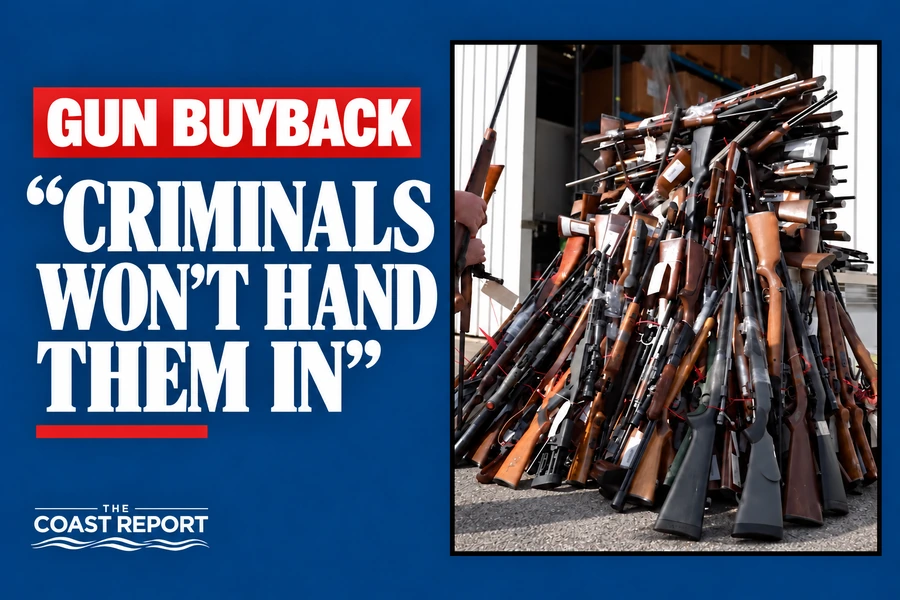
Shooters Union Australia is urging licensed owners to boycott the NSW gun buyback, challenging government claims it will make communities safer and arguing it targets law-abiding people while leaving illegal weapons in criminals’ hands.
The scheme begins on November 2, compensating eligible owners who surrender firearms affected by tighter ownership limits, bans and reclassifications introduced after the December 2025 Bondi Beach terror attack.
An initial six collection stations will accept firearms.
The union wants owners to hold off participating until after the March state election, backing its campaign with research and economic modelling it says undermine the government’s safety case.
The boycott push follows a Liberal backflip.
After supporting the post-Bondi reforms, the NSW Liberals have pledged to freeze the buyback, scrap ownership caps for primary producers and establish an inquiry into firearms laws if elected.
Riverina farmer Tony Clough, from Windermere, questioned whether criminals would turn up at police stations.
“I think it’s absolutely ridiculous because the criminals out there have got guns and plenty of them, and are you going to see them drop back down to the local police station and hand their guns in?” he told 7NEWS.
Union challenges safety claims
Shooters Union Australia has outlined its arguments on its Stop the Buyback campaign website.
The campaign draws on a Tulipwood Economics report commissioned by Shooters Union Australia and the Shooting Industry Foundation of Australia.
According to the union’s community information paper, the analysis found no statistically significant relationship between firearm numbers and mass shooting deaths from 1968 to 2024, and no robust evidence that reducing registered firearm numbers would lower firearm homicides after accounting for long-term trends.
The paper points to NSW firearm assault hospitalisations falling from 40 in 2015–16 to 13 in 2023–24, and says firearm theft has more than halved since 2016 despite growing registered ownership.
The union argues those trends undermine the case for targeting firearm numbers, although they do not establish that a buyback would have no safety benefit.
Illegal guns outside its reach
The union’s paper cites an estimated Australian illicit firearms pool of at least 250,000 longarms and 10,000 handguns, identifying unsurrendered “grey market” firearms, theft and illegal manufacture among the sources of supply.
It argues buying registered firearms from licensed owners will not directly remove weapons already held illegally, and advocates stronger storage enforcement to tackle theft.
The paper also warns restrictions could reduce volunteer hunting and pest-control work. It cites an estimated $1.35 billion annual cost of invasive species to NSW, saying any additional burden from lost volunteer effort is excluded from the economic modelling.
Nearly $1 billion warning
Tulipwood models approximately $950.6 million in economic and social costs if 20 per cent of registered firearms are surrendered, including compensation, administration and wider community and business impacts.
The estimate is not a government budget figure and predates the August compensation announcement.
In an abridged conclusion reproduced by the union, Tulipwood warns the scheme is likely to impose substantial community costs while “failing to achieve its stated objectives”.
Minns defends crackdown
The NSW Government says the buyback will remove firearms no longer permitted under tougher laws, alongside stronger licensing checks and oversight.
“Fewer dangerous guns in our community means a safer New South Wales,” Premier Chris Minns said.
Police Minister Yasmin Catley has asked affected owners to be patient, saying everyone affected will have the opportunity to participate.
The government cites research on the 1996 Port Arthur reforms, pointing to 13 mass shootings in the preceding 18 years and none in the following two decades. It says the reforms were associated with faster declines in firearm deaths, particularly suicides, while acknowledging other factors can influence the outcomes.
What owners face
The legislation sets a four-firearm limit for recreational hunters and a limit of 10 for primary producers. Target shooters and pest controllers can hold 10, or a higher number approved by the Police Commissioner under the regulations.
Straight-pull, pump-action and button or lever-release firearms will move into the more restricted category C, although the government says those provisions have not commenced and dates remain undetermined.
Phase one compensation ranges from $450 for an air rifle to $1000 for a revolver or centrefire rifle, with a flat payment for ammunition surrendered alongside eligible firearms.
Phase two, due in early 2027, will offer a separate valuation pathway for eligible firearms worth more than $3000, with compensation capped at $10,000 per firearm and a fee applying.
The government estimates about 50,000 licence holders and up to 274,000 registered firearms could be affected—potential impact figures, rather than confirmed surrenders.
Read more: Northern Rivers police and court news from The Coast Report